
More than 10 years ago, Arina Borevich was a cook at a remote marine science research station on an island in northern Russia, when she saw her first nudibranch. It was brilliantly colored, with hues and textures that seemed almost impossible. She became fascinated by these colorful slugs, and used her talent as an artist to make needle-felted sculptures of them as gifts for a few of the scientists at the station who studied nudibranchs. A single model, made of sheep wool, can take as long as 12 hours of work to create.
After making a few for the scientists she worked with, Arina opened an Etsy shop, which is where I first discovered her work. I suspect more of her customers were nerdy scientists like me - I saw her Etsy site, and asked if she could make a species that a dear friend (and slug fan) studies. When I saw it, it was all I could do to send it to my friend (sorry Dave!) - it was so beautiful, I really wanted to keep it. But somehow I managed to part with it.
“These impossibly colorful sea slugs with shapes and patterns that looked like they came from another planet”
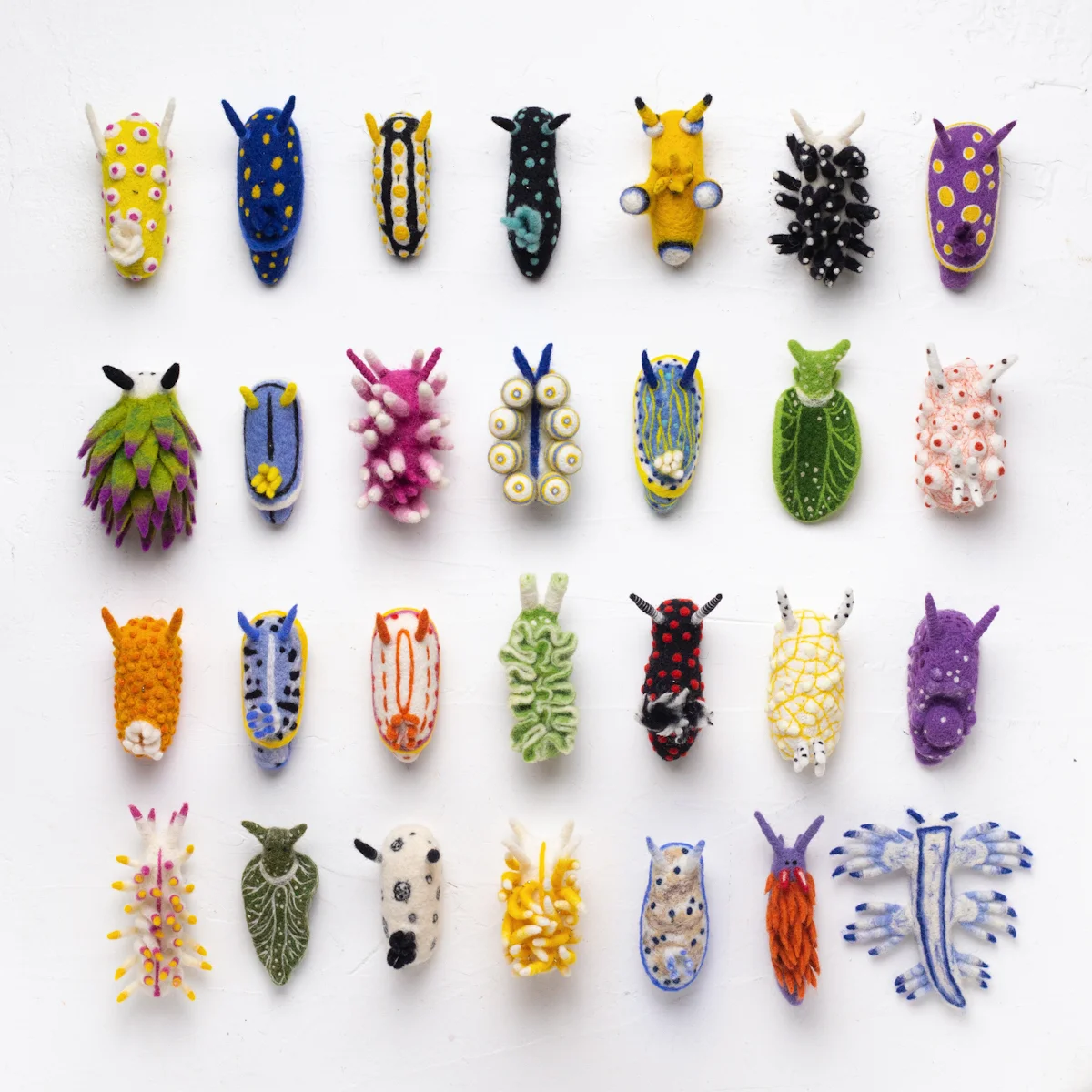
Just some of the range of sea slugs from the Wool Creature Lab
Her craft IS science
Her work requires an eye for detail rivaling that of any taxonomist. She creates these felted sculptures with incredible anatomical fidelity, capturing details like the cerata (the fingerlike projections on a nudibranch’s back that are both gills and sometimes defensive weapons); the rhino-horse (the little sensory “horns” that project from their heads), and layer by layer matching color and texture remarkably like that of the real slug.
science communication
Most people do not know that nudibranchs exist. Yet there are 3,000 species, across every ocean on the planet. The diversity is astounding - they range from tiny (2 mm!) to ones that can get up to 60 cm; some store toxins they use for self-defense, others steal stinging cells from jellyfish and use those for defense; others store chloroplasts so they can reap the benefits of photosynthesis. Arina’s goal is strategic, not whimsical. If she puts something attractive and tactile into someone’s hand, it leads to greater appreciation for (and interest in) nudibranchs.
More than 20 of her pieces have been exhibited at the Xiamen International Art Festival in China. She left Russia three years ago under difficult circumstances, and rebuilt her practice across three countries before landing in Tbilisi, Georgia (no, not THAT Georgia - the country). Her shop sells out every time she restocks.
art and science
There is a long tradition of scientific illustration - I think of Ernst Haeckel’s lithographs or A.R. Valentien’s paintings of California plants. Arina is keeping that tradition alive, but in a novel way. What makes her work so interesting to me is (besides the beauty of her pieces) how she is learning the taxonomy, ecology, and morphology of nudibranchs, and then turning that into objects that put that knowledge in a form you can hold in your hand. In some ways that is more powerful than simple explaining how cool nudibranchs are - people get to “feel” the animal, which will spark more interest and questions.
I hear that she is also thinking of developing DIY kits so that people can felt their own nudibranch models. I like the idea of people picking up their tools, building the structures one by one, and after those hours of work you may start to understand why someone would spend their career studying these animals, and hopefully come up with questions and interests of their own.
More than 3,000 species, at six to twelve hours each: the nudibranchs are coming!
Find Arina Borevich’s work
Website: woolcreaturelab.com · Instagram: @wool_creature_lab · Patreon: patreon.com/arinaborevich — where she gives away a handmade nudibranch each month.